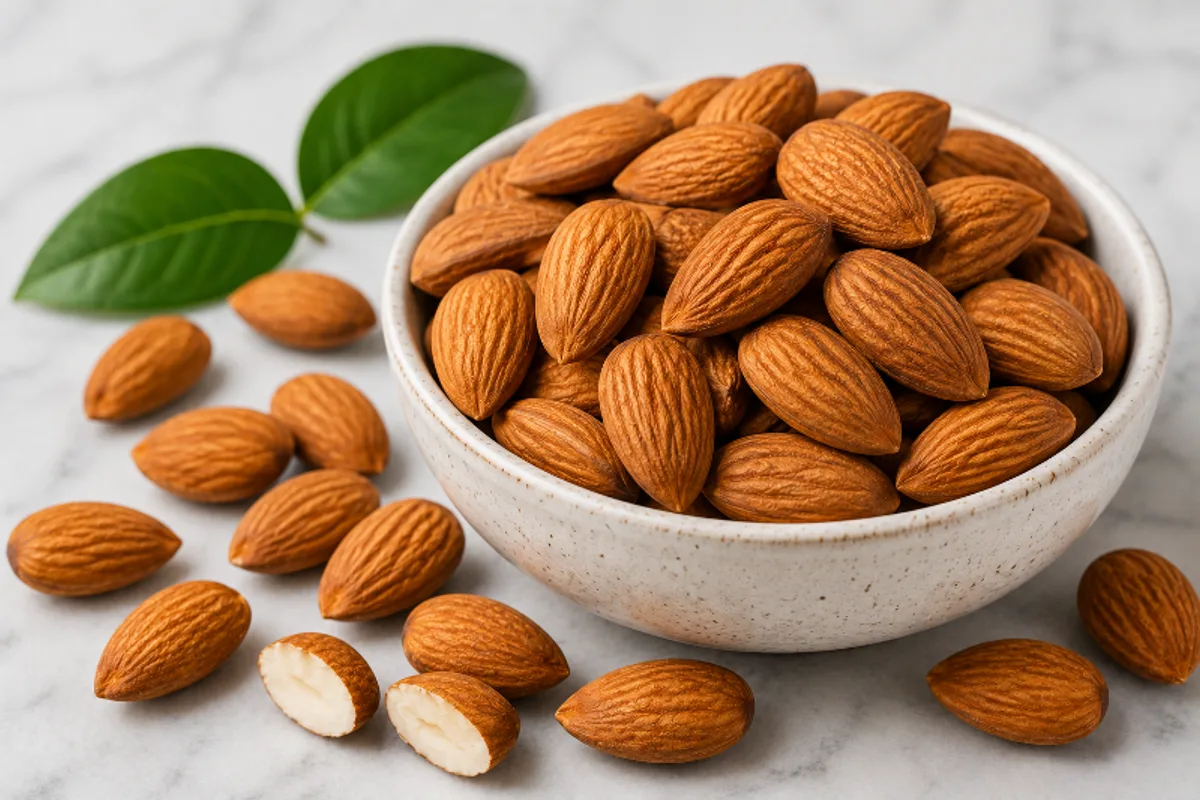
When you eat almonds, your body digests protein, fiber, and mostly unsaturated fat over a slower timeline than refined snacks. Almonds deliver vitamin E, magnesium, and modest protein per ounce. Their crunch and fat content support satiety for many people, but calories are concentrated—portion size matters more than "unlimited nuts" myths.
Key takeaways
The essentials in plain language—useful before the deep dive.
✓
One ounce (~23 almonds) packs healthy fats, fiber, protein, and vitamin E in a small volume.
✓
Fat and fiber slow digestion compared with sugary snacks—helpful for satiety for many people.
✓
Calories are concentrated; "handful" portions can add up without noticing.
✓
Tree nut allergies are serious—avoid almonds entirely if allergic.
Quick answers
Short answers to common questions—details follow below.
How many almonds should you eat per day?
About 1 ounce (23 almonds) is a common research serving and a practical daily portion for most healthy adults.
Are raw or roasted almonds better?
Nutrient differences are modest. Choose forms you enjoy without excess added salt or sugar.
Do almonds help with weight loss?
Almonds can improve satiety, but weight change still depends on total calories. They help when they replace higher-calorie snacks—not when added on top without adjustment.
Is almond butter the same as whole almonds?
Similar nutrients, but butter is easier to overeat and may include added oils or salt—check labels and portion carefully.
What happens if you eat almonds every day?
A small handful delivers unsaturated fat, vitamin E, fiber, and plant protein. Watch portions—nuts are calorie-dense.
Are almonds good for weight loss?
Portion-controlled almonds can support satiety; unlimited snacking can stall weight goals.
What happens over time
A typical timeline after eating Almond—not a personal medical forecast. Individual responses vary.
●
0–15 minutes
Step 1 Evidence: Strong
First bites
What happens: Chewing crushes cell walls, releasing oils and protein. Fat slows gastric emptying versus low-fat, high-sugar snacks.
Pattern certainty: typical
●
1–4 hours
Step 2 Evidence: Moderate
Digestion & absorption
What happens: Fats digest into fatty acids; protein breaks into amino acids. Some almond fat may pass unabsorbed when nuts are whole—minor calorie variability.
Pattern certainty: variable
●
2–5 hours
Step 3 Evidence: Moderate
Satiety window
What happens: Combined fat, protein, and fiber often prolong fullness compared with refined carbohydrate snacks of similar calories.
Pattern certainty: typical
●
24 hours–1 week
Step 4 Evidence: Strong
Daily pattern
What happens: Small daily nut portions fit Mediterranean-style patterns linked with favorable lipid profiles when they replace less healthy fats.
Pattern certainty: typical
●
Weeks to years
Step 5 Evidence: Strong
Longer-term pattern
What happens: Regular nut intake within calorie-balanced diets associates with better cardiometabolic markers in many studies—not license to eat unlimited amounts.
Pattern certainty: typical
●
0–15 minutes
Evidence: Strong
First bites
What: Chewing crushes cell walls, releasing oils and protein. Fat slows gastric emptying versus low-fat, high-sugar snacks.
●
1–4 hours
Evidence: Moderate
Digestion & absorption
What: Fats digest into fatty acids; protein breaks into amino acids. Some almond fat may pass unabsorbed when nuts are whole—minor calorie variability.
●
2–5 hours
Evidence: Moderate
Satiety window
What: Combined fat, protein, and fiber often prolong fullness compared with refined carbohydrate snacks of similar calories.
●
24 hours–1 week
Evidence: Strong
Daily pattern
What: Small daily nut portions fit Mediterranean-style patterns linked with favorable lipid profiles when they replace less healthy fats.
●
Weeks to years
Evidence: Strong
Longer-term pattern
What: Regular nut intake within calorie-balanced diets associates with better cardiometabolic markers in many studies—not license to eat unlimited amounts.
Nutrient snapshot
Serving size: 1 oz almonds (~28 g, ~23 nuts)
At a glance
Calories
164 kcal
Protein
6 g
Fat
14 g
Carbs
6 g
Fiber
3.5 g
Sugar
1.2 g
Vitamin highlights
Vitamin E ~7.3 mg 49% DV
Riboflavin ~0.3 mg 23% DV
Minerals
Magnesium ~76 mg 18% DV
Calcium ~76 mg 6% DV
% Daily Value based on a general 2,000-calorie reference diet where shown. Values are approximate.
Source: USDA FoodData Central (approximate values for raw almonds)
Benefits
Potential upsides when this food fits a balanced pattern—not guaranteed outcomes for every person.
Vitamin E and healthy fats
Evidence: Strong
Almonds are one of the richest common food sources of vitamin E, mostly as unsaturated fat that fits heart-conscious dietary patterns.
Honey-roasted or heavily salted products are different from raw almonds—read labels.
Who should limit this food
Educational context only—not a diagnosis tool. When in doubt, ask a qualified clinician.
!
Tree nut allergy
Strict avoidance; almonds are a tree nut allergen.
!
Swallowing difficulty
Whole nuts are a choking risk for some older adults and young children—use nut butters or ground forms when appropriate.
!
Calorie-restricted medical plans
Portion almonds carefully within prescribed calorie targets.
How much & how often
A standard serving is 1 ounce (about 23 almonds) per day or several times per week as part of a balanced diet. Nuts should replace less healthy snacks or fats—not stack endlessly on top of an already high-calorie diet.
Almond composition is well characterized. Nut consumption trials and cohorts support cardiovascular and metabolic benefits when nuts displace less healthy foods within calorie-controlled diets. Vitamin E and magnesium contributions are meaningful at ounce portions; benefits do not scale linearly with unlimited intake.
Evidence in this article
Randomized controlled trials
Lipid and glycemic effects of daily almond portions versus control snacks.
Observational cohorts
Nut intake associated with cardiovascular outcomes over years.
Food composition data
USDA macronutrient and micronutrient profiles per ounce.
Hierarchy of evidence
1
Systematic reviews & guidelines
Highest synthesis
2
Randomized trials
Strong causal designs
3
Observational studies
Association signals
4
Mechanistic / lab
Hypothesis-generating
Higher on this list generally means stronger confidence for public guidance—but every design has limits.
Calorie labels overestimate absorbed energy slightly for whole nuts, but portion discipline still matters.
Roasted, flavored, and butter forms differ nutritionally from raw nuts.
In depth
The short story
Almonds are calorie-dense seeds (yes, botanically related to stone fruits) rich in unsaturated fat, protein, fiber, and vitamin E. Your body digests them more slowly than crackers or candy, which is why they often feel more satisfying per bite.
Portion is the story
The nutrition research serving—about one ounce—fits in a small palmful. Without measuring, it is easy to double portions and wonder why weight goals stall. Pre-portion bags or scales beat guessing.
Heart pattern context
Nuts appear in Mediterranean and portfolio dietary patterns studied for lipid benefits. Almonds help when they replace butter-heavy snacks or refined carbs—not when they pile on top of an already energy-surplus diet.
Bottom line
Almonds are an evidence-supported whole-food snack at sensible portions. Measure servings, skip if you have tree nut allergy, and treat flavored products as separate from plain raw nuts.
Frequently asked questions
How many almonds should you eat per day?
+
About 1 ounce (23 almonds) is a common research serving and a practical daily portion for most healthy adults.
Are raw or roasted almonds better?
+
Nutrient differences are modest. Choose forms you enjoy without excess added salt or sugar.
Do almonds help with weight loss?
+
Almonds can improve satiety, but weight change still depends on total calories. They help when they replace higher-calorie snacks—not when added on top without adjustment.
Is almond butter the same as whole almonds?
+
Similar nutrients, but butter is easier to overeat and may include added oils or salt—check labels and portion carefully.
What happens if you eat almonds every day?
+
A small handful delivers unsaturated fat, vitamin E, fiber, and plant protein. Watch portions—nuts are calorie-dense.
Are almonds good for weight loss?
+
Portion-controlled almonds can support satiety; unlimited snacking can stall weight goals.
Do almonds lower cholesterol?
+
Nuts within heart-healthy patterns are associated with favorable lipid markers; they do not replace prescribed therapy.
Is almond milk as nutritious as whole almonds?
+
Usually no—many almond milks are diluted and lower in protein and fiber than a serving of nuts.
References
Sources used in this explainer. External links open in a new tab.

 Evidence: Strong
 Evidence: Moderate
 Evidence: Strong
 Evidence: Moderate
 Evidence: Strong
 Evidence: Strong