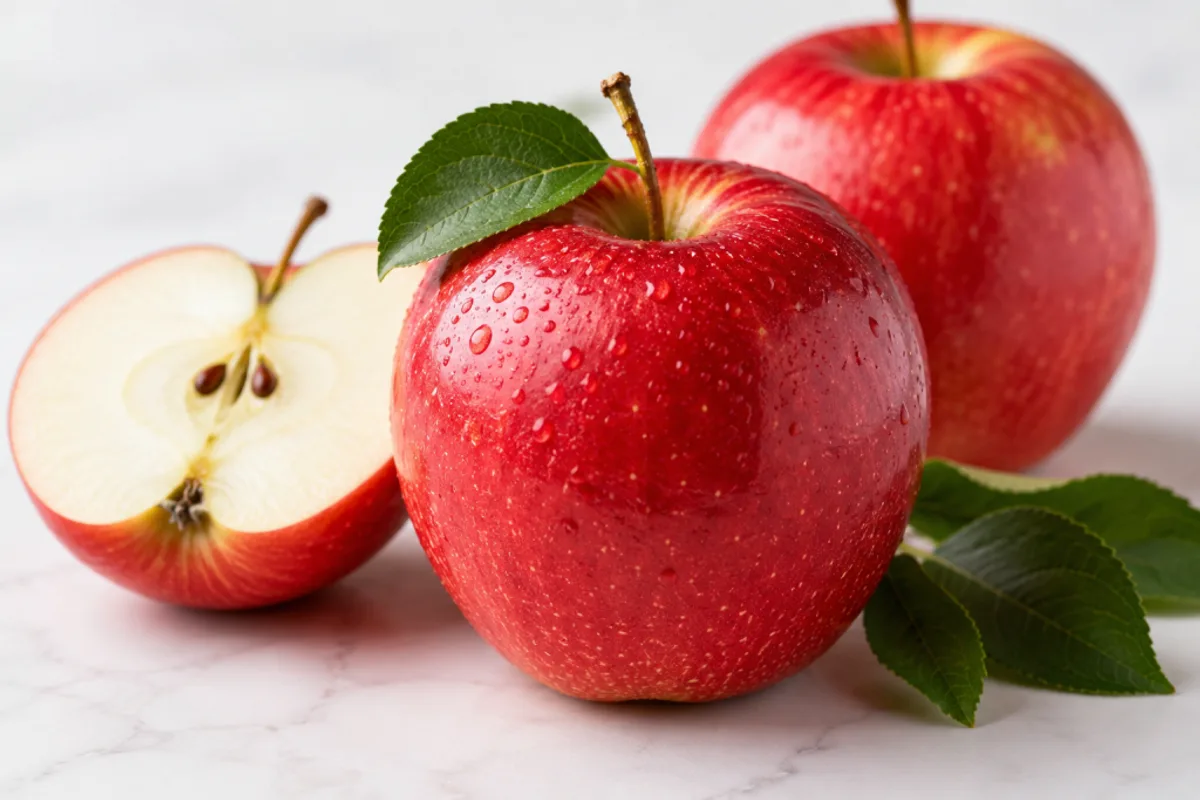
When you eat a whole apple, your body digests natural sugars within a fiber-rich food matrix. Fiber (especially with the skin) supports fullness and gut transit, while modest vitamin C and plant compounds add to overall produce intake. Benefits track with overall diet quality—not miracle claims—and juice is not equivalent to whole fruit.
Key takeaways
The essentials in plain language—useful before the deep dive.
✓
Whole apples deliver water, fiber (including pectin), and natural sugars digested at a moderate pace for most people.
✓
The skin holds a large share of fiber and polyphenols—wash well and keep it when you can.
✓
About 95 calories and 4+ g fiber per medium apple supports snack swaps for many goals.
✓
Regular fruit intake fits heart- and gut-friendly patterns when it replaces ultra-processed snacks.
✓
Apple juice removes most fiber and makes it easy to overconsume sugar without fullness.
✓
Benefits track with overall diet quality—not miracle “superfruit” claims.
Quick answers
Short answers to common questions—details follow below.
Can you eat an apple every day?
Yes, for most healthy people a daily medium apple is a reasonable way to add fiber and fruit. Variety still matters across the week.
Is it healthy?
Whole apples fit well in evidence-based eating patterns. Benefits come from fiber, water, and replacing ultra-processed snacks—not from miracle claims.
What is the best serving?
One medium apple with the skin (~182 g) is a common serving. Pair with protein or fat if you want a more filling snack.
Who should avoid or limit apples?
People with apple allergy, some with oral allergy syndrome (raw), and anyone on a clinician-prescribed carb limit should personalize. Young children need safe textures.
Can children eat apples?
Yes with age-appropriate textures—slice, cook, or soft-serve forms reduce choking risk for younger kids.
Pregnancy?
Whole fruit including apples generally fits prenatal produce goals. Wash produce; follow your clinician for special diets.
Diabetes?
Whole apples can fit many plans because of fiber and the food matrix. Portion size, pairing, and personal glucose data matter more than a ban.
Weight loss?
Apples can support volume and fiber when they replace higher-calorie snacks. No fruit “burns fat” on its own.
What happens over time
A typical timeline after eating Apple—not a personal medical forecast. Individual responses vary.
◉
30 minutes
Step 1 Evidence: Strong
First bites
What happens: Chewing breaks cell walls and mixes fruit with saliva. You taste natural sweetness while fiber begins structuring the food bolus.
Why: Mechanical breakdown and saliva enzymes start carbohydrate digestion; the intact food matrix still matters.
Pattern certainty: typical
Caution: Individual chewing and saliva flow vary; this is a typical pattern, not a stopwatch.
⬡
2 hours
Step 2 Evidence: Moderate
Digestion & absorption
What happens: Carbohydrates break down into absorbable sugars (glucose and fructose). Fiber often slows gastric emptying versus a low-fiber sweet snack.
Why: Viscous fiber and intact cell walls change how quickly sugars appear in the bloodstream for many people.
Pattern certainty: typical
Caution: Blood-glucose responses still vary—especially with diabetes or insulin resistance.
◎
24 hours
Step 3 Evidence: Strong
Gut transit & fermentation
What happens: Insoluble fiber adds bulk; soluble fiber such as pectin is fermented by gut microbes, producing short-chain fatty acids that support colon cells.
Why: Microbes use fermentable fibers as substrates; short-chain fatty acids help nourish the colon lining.
Pattern certainty: typical
▦
1 week
Step 4 Evidence: Moderate
Daily pattern
What happens: Repeated servings contribute to total fiber and fruit goals. Hydration, overall diet, and activity still shape digestion more than any single food.
Why: Fiber needs and gut comfort depend on total intake and fluid—not one apple in isolation.
Pattern certainty: variable
◷
1 month
Step 5 Evidence: Moderate
Steady habit
What happens: A daily apple habit can make meeting fruit and fiber targets easier if it replaces less nutritious snacks.
Why: Convenience and taste drive adherence; adherence drives diet quality more than any single nutrient headline.
Pattern certainty: variable
◈
Long term
Step 6 Evidence: Strong
Longer-term pattern
What happens: Higher fruit intake as part of a balanced pattern is associated with better diet quality and favorable cardiometabolic markers—not because apples reverse disease alone.
Why: Population research reflects overall patterns, sodium, activity, and smoking status—not an apple-only cure.
Pattern certainty: typical
Caution: Population associations are not the same as clinical treatment effects.
◉
30 minutes
Evidence: Strong
First bites
What: Chewing breaks cell walls and mixes fruit with saliva. You taste natural sweetness while fiber begins structuring the food bolus.
Why: Mechanical breakdown and saliva enzymes start carbohydrate digestion; the intact food matrix still matters.
Caution: Individual chewing and saliva flow vary; this is a typical pattern, not a stopwatch.
⬡
2 hours
Evidence: Moderate
Digestion & absorption
What: Carbohydrates break down into absorbable sugars (glucose and fructose). Fiber often slows gastric emptying versus a low-fiber sweet snack.
Why: Viscous fiber and intact cell walls change how quickly sugars appear in the bloodstream for many people.
Caution: Blood-glucose responses still vary—especially with diabetes or insulin resistance.
◎
24 hours
Evidence: Strong
Gut transit & fermentation
What: Insoluble fiber adds bulk; soluble fiber such as pectin is fermented by gut microbes, producing short-chain fatty acids that support colon cells.
Why: Microbes use fermentable fibers as substrates; short-chain fatty acids help nourish the colon lining.
▦
1 week
Evidence: Moderate
Daily pattern
What: Repeated servings contribute to total fiber and fruit goals. Hydration, overall diet, and activity still shape digestion more than any single food.
Why: Fiber needs and gut comfort depend on total intake and fluid—not one apple in isolation.
◷
1 month
Evidence: Moderate
Steady habit
What: A daily apple habit can make meeting fruit and fiber targets easier if it replaces less nutritious snacks.
Why: Convenience and taste drive adherence; adherence drives diet quality more than any single nutrient headline.
◈
Long term
Evidence: Strong
Longer-term pattern
What: Higher fruit intake as part of a balanced pattern is associated with better diet quality and favorable cardiometabolic markers—not because apples reverse disease alone.
Why: Population research reflects overall patterns, sodium, activity, and smoking status—not an apple-only cure.
Caution: Population associations are not the same as clinical treatment effects.
Nutrient snapshot
Serving size: 1 medium apple with skin (~182 g)
At a glance
Calories
95 kcal
Protein
0.5 g
Fat
0.3 g
Carbs
25 g
Fiber
4.4 g
Sugar
19 g
Vitamin highlights
Vitamin C ~8.4 mg 9% DV
Vitamin A ~98 IU 2% DV
Minerals
Potassium ~195 mg 4% DV
Calcium ~11 mg 1% DV
% Daily Value based on a general 2,000-calorie reference diet where shown. Values are approximate.
Source: USDA FoodData Central (approximate values for a medium raw apple with skin)
Benefits
Potential upsides when this food fits a balanced pattern—not guaranteed outcomes for every person.
Supports fiber intake
Evidence: Strong
A medium apple provides about 4+ grams of fiber, which helps many people meet daily fiber targets linked with regular bowel habits.
How confident we are in key claims—and why that grade was assigned.
Evidence: Strong
Food composition and fiber content of whole apples are well characterized.
Why this grade: USDA FoodData Central and laboratory composition methods provide consistent macro and fiber estimates for raw apple with skin.
Evidence: Strong
Dietary fiber supports regularity and is part of cardiometabolic guidance.
Why this grade: Fiber mechanisms and public-health recommendations are supported by extensive clinical nutrition literature and guidelines—not apple-only trials.
Evidence: Moderate
Higher fruit intake patterns associate with better heart-health markers.
Why this grade: Large observational cohorts and AHA-aligned guidance support produce-rich diets; they do not prove an apple-only disease effect.
Evidence: Limited
Polyphenol extracts do not equal whole-apple kitchen doses.
Why this grade: Many polyphenol studies use concentrated extracts or lab models that overstate what one fruit serving delivers.
Risks & downsides
Balanced context—not scare headlines. Dose, preparation, and personal health history all matter.
Natural sugars still count
Fruit sugars contribute calories. Large amounts of juice can add sugar quickly without much fullness compared with whole fruit.
Apple seeds contain trace amygdalin. Accidentally eating a few seeds is not a practical concern for most people; intentionally eating many seeds is unwise.
Oral allergy syndrome
People with birch-pollen related oral allergy syndrome may experience mouth itching with raw apple; cooking often reduces symptoms for some—confirm with an allergist when needed.
Who should limit this food
Educational context only—not a diagnosis tool. When in doubt, ask a qualified clinician.
!
Known apple allergy
Avoid apples and follow clinician guidance for diagnosis and alternatives.
!
Oral allergy syndrome
Raw apple may trigger itching or tingling; discuss cooked forms and testing with an allergist.
!
Diabetes or blood-sugar management
Whole fruit can fit many plans, but portions and pairing matter. Use personal glucose data and clinician advice—not a single food rule.
!
Carbohydrate-restricted medical diets
Follow your care team’s prescribed plan; do not override clinical instructions with general articles.
!
Children
Whole apples can be a choking risk for young children—serve age-appropriate textures (soft, sliced, or cooked).
!
Older adults with chewing difficulty
Soft or cooked apple preparations may be easier while still providing fiber when skin is tolerated.
Best ways to eat
Form and preparation change fiber, fullness, and how nutrients are available—not a ranking of “good vs bad.”
Fresh (raw, with skin)
Keeps pectin and skin polyphenols; wash thoroughly.
Pros
+
Highest fiber retention for most people
+
Portable snack with no prep heat loss
Cons
−Texture can be hard for some teeth or jaws
−Raw form may bother oral allergy syndrome
Sliced raw
Same nutrients as whole raw if skin is kept; lemon juice slows browning.
Pros
+
Easier chewing and portioning
+
Kid-friendlier than whole fruit
Cons
−Surface browns with air exposure
Cooked / baked
Softens fiber structure; still contributes fiber if skin is included when tolerated.
Pros
+
Softer texture for older adults and recovery meals
+
Easy to pair with spices instead of sugar
Cons
−Some heat-sensitive vitamin C loss
Stewed / sauce (unsweetened)
Prefer unsweetened; fiber remains higher than juice.
Pros
+
Gentle on chewing and digestion for some
Cons
−Easy to add sugar commercially
Juice
Not equivalent to whole fruit for satiety or fiber goals.
Pros
+
Convenient hydration vehicle for some
Cons
−Most fiber removed
−Easy to overconsume sugar without fullness
Frozen (for smoothies)
Keep the whole fruit in the blend; avoid juice bases.
Pros
+
Year-round convenience
+
Blends well with protein foods
Cons
−Smoothies can hide large portions
How much & how often
For most healthy adults, one medium apple is a reasonable single serving. Many dietary patterns encourage about 1.5–2 cups of fruit daily from a variety of sources. There is no universal “perfect” apple quota—total diet, activity, and individual needs matter more than any single number.
The strongest evidence for apples sits inside broader fruit-and-fiber research—nutrient composition is well characterized (food composition databases), fiber mechanisms are well described, and higher fruit intake patterns associate with better cardiometabolic markers in population studies. Claims that a daily apple uniquely “cures” disease are not supported.
Evidence in this article
Food composition data
Laboratory analyses that estimate calories, macros, fiber, and micronutrients per serving.
Mechanistic & clinical nutrition research
Studies on fiber viscosity, fermentation, and glycemic responses to whole foods versus juices.
Observational cohorts
Large populations linking fruit patterns with long-term health markers—association, not proof of causation for a single food.
Guidelines & systematic reviews
Expert syntheses that inform public fruit and sugar recommendations.
Hierarchy of evidence
1
Systematic reviews & guidelines
Highest synthesis
2
Randomized trials
Strong causal designs
3
Observational studies
Association signals
4
Mechanistic / lab
Hypothesis-generating
Higher on this list generally means stronger confidence for public guidance—but every design has limits.
Research limitations
Many human outcomes come from observational diets, not apple-only randomized trials.
Polyphenol research often uses extracts or in vitro models that do not equal whole-food effects at kitchen doses.
Individual glycemic responses vary; group averages do not predict one person’s numbers.
Common myths
Claims you may have heard—explained with evidence, not scare tactics.
Claim
“An apple a day guarantees you never get sick”
False Evidence: Strong
No single food prevents all illness. Apples can support produce-rich patterns linked with better diet quality, but immunity depends on sleep, vaccines, overall nutrition, and many other factors.
Claim
“Apple juice is basically the same as eating an apple”
False Evidence: Strong
Juicing removes most fiber and changes fullness and sugar pace. Whole fruit remains the better default for most people.
Claim
“Apples burn belly fat”
False Evidence: Strong
Apples do not create a fat-burning furnace. They may help weight management only when they displace higher-calorie foods inside a calorie-aware pattern.
Claim
“Green apples are dramatically healthier than red”
Misleading Evidence: Moderate
Variety differences exist, but they are usually smaller than the gap between eating fruit and not eating fruit. Choose what you will eat consistently.
In depth
The short story
An apple is mostly water and carbohydrate, with a meaningful dose of fiber when you eat it whole—especially with the skin. Your body does not treat it like candy or like a multivitamin. It treats it like food: chew, digest, absorb, and ferry nutrients and plant compounds through familiar metabolic pathways.
Digestion, fiber, and fullness
When you bite an apple, mechanical chewing and enzymes begin breaking starch and sugars into absorbable forms. The food matrix matters. Fiber—about 4+ grams in a medium apple—slows the meal’s path for many people and contributes to fullness compared with refined snacks of similar sweetness.
Soluble fibers such as pectin form viscous gels and are fermented by gut bacteria. That fermentation produces short-chain fatty acids that help nourish colon cells. This is one reason whole fruit shows up so often in gut-friendly eating patterns—not because apples “detox” anything (they don’t), but because they reliably add fiber and water.
Blood sugar and energy
Apples contain natural sugars, including fructose and glucose. In whole form, fiber and structure typically moderate how quickly those sugars appear in the bloodstream relative to sugar-sweetened beverages. That does not mean apples are free of metabolic effect, and it does not replace individualized advice for people managing diabetes.
If energy stability is your goal, pairing fruit with protein or fat at meals (for example yogurt or nuts) is a practical pattern many dietitians use—as part of overall diet design, not a rigid rule.
Nutrients and plant compounds
Beyond fiber, apples contribute vitamin C and a range of polyphenols. Concentrations are often higher in and near the skin, which is a simple argument for washing well and eating the peel when you tolerate it. Nutrient amounts are modest per fruit; apples work best as part of a varied produce pattern rather than as a sole “source of everything.”
Long-term health context
Population research generally supports higher fruit intake as part of dietary patterns linked with better cardiometabolic health. Apples are one convenient, affordable way to move in that direction—especially when they replace ultra-processed snack foods. Treat headlines that promise disease reversal from a single fruit with skepticism; patterns beat magic foods.
Practical tips
Prefer whole apples over juice for fiber and fullness.
Keep the skin when you can; wash under running water.
Pair with protein or fat if you want a more satisfying snack.
Choose whatever variety you enjoy—consistency beats perfection.
Store most apples refrigerated to maintain texture and quality.
Closing note
Eating an apple is a simple, evidence-aligned way to add fiber, fluid, and plant compounds to your day. Your body digests it like other whole fruits: sugars are absorbed, fiber shapes gut transit and microbial fermentation, and long-term benefits track with overall diet quality—not miracle claims.
Compare this food
Side-by-side guides to help you choose with context—not hype.
Usually yes. The skin holds a large share of the fiber and many polyphenols. Wash thoroughly. If texture is difficult, keep the skin when you can and pair apples with other high-fiber foods.
Whole apples typically have a more moderate effect than sugary drinks because of fiber and the food matrix. Responses still vary—especially with diabetes—so personal monitoring and clinician advice matter more than a single food rule.
Is apple juice as healthy as eating an apple?
+
No. Juice removes most of the fiber and makes it easy to consume more sugar with less fullness. Prefer whole fruit most of the time.
For most people, a daily apple is a simple way to increase fruit and fiber. Benefits come from overall diet quality, not from any single “superfood” effect.
Are green and red apples nutritionally very different?
+
Differences are usually modest compared with the shared benefits of whole fruit. Choose the variety you will actually eat consistently.
How many calories are in a medium apple?
+
About 95 calories for a medium apple with skin, mostly from natural sugars plus fiber.
Can apples help with constipation?
+
Fiber and fluid from whole apples can support regularity for many people; results vary with overall fiber and hydration.
Is it OK to eat an apple every day?
+
Yes for most healthy people as part of fruit intake goals. Wash produce and personalize if you have oral allergy syndrome.
Bottom line
Should you eat apple?
Should you eat it?
Yes—for most healthy people, whole apples are a practical, evidence-aligned fruit choice.
Who benefits most?
Anyone building fiber intake, swapping out ultra-processed snacks, or looking for a portable whole-fruit option.
How much?
About one medium apple per sitting; aim for varied fruit across 1.5–2 cups daily as part of overall diet.
Main caution
Prefer whole fruit over juice; personalize for allergy, oral allergy syndrome, diabetes, and chewing or choking risk.
Keep the skin when you can, wash well, and treat apples as one useful piece of a varied produce pattern—not a cure-all.
References
Sources used in this explainer. External links open in a new tab.
The information has been researched, written, and fact-checked using publicly available
scientific literature and trusted health organizations.
Our goal is to explain nutrition science in plain language while avoiding exaggerated or
misleading health claims.
This content is not personalized medical advice and should not replace guidance from your
healthcare professional.
Fact-check sources used in this article
✓
USDA FoodData Central
✓
PubMed indexed research
✓
World Health Organization (WHO)
✓
American Heart Association
✓
Systematic reviews and evidence-based nutrition guidelines
Last updated:
Prepared by the WhatHappenIfYouEat Editorial Team — not a substitute for clinical care.
Quality checks performed
✓
Checked nutrition figures against USDA approximations, fiber and cardiometabolic claims against major reviews, and balanced risk language for sugars and oral allergy syndrome.
Educational content only.
This article explains current nutrition evidence and is not intended to diagnose, treat,
cure, or prevent any disease.

 Evidence: Strong
 Evidence: Moderate
 Evidence: Strong
 Evidence: Strong
 Evidence: Moderate
 Evidence: Moderate