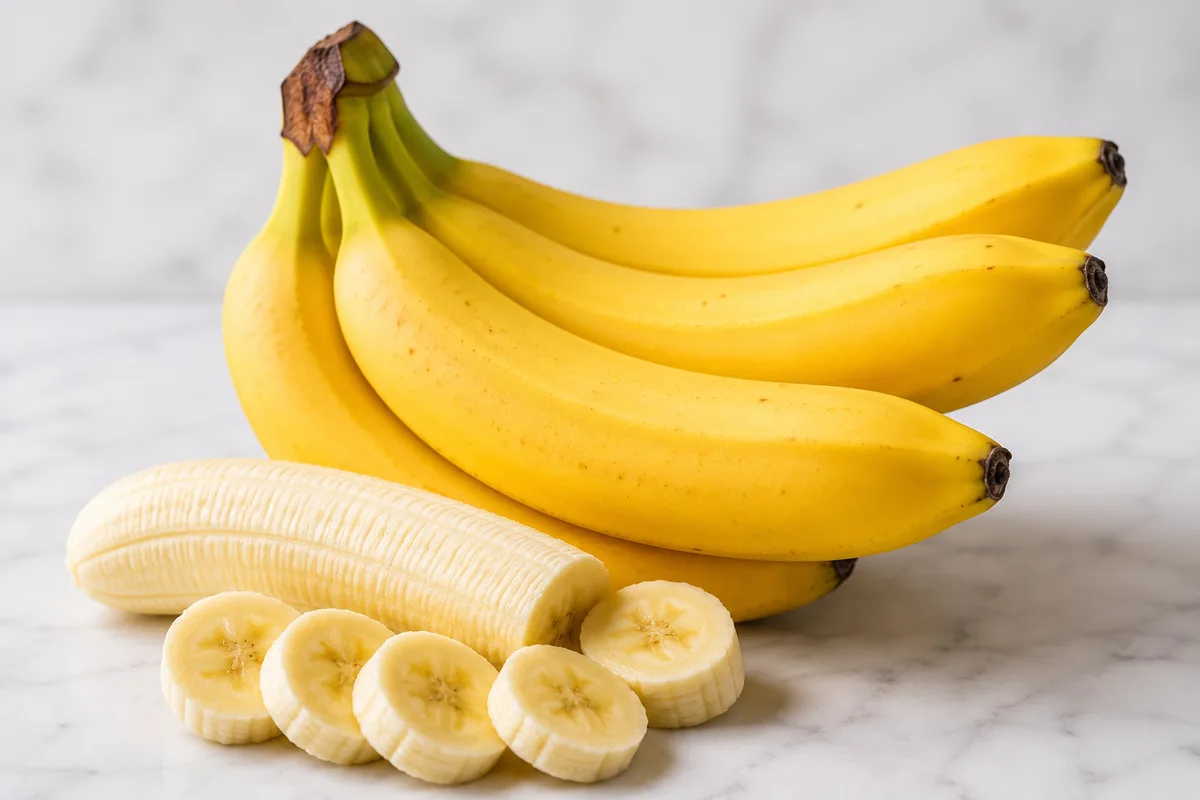
When you eat a banana, your body quickly digests its natural sugars and starch while absorbing potassium, vitamin B6, and modest fiber. Riper bananas have more free sugars and less resistant starch; greener ones may feel heavier for some people. Benefits track with overall fruit intake—not single-food miracles—and portion size matters for blood-sugar management.
Key takeaways
The essentials in plain language—useful before the deep dive.
✓
Bananas deliver quick-digesting carbohydrates plus potassium and vitamin B6 in a portable whole-food package.
✓
Ripeness changes the sugar-to-starch ratio—greener bananas have more resistant starch; riper ones taste sweeter.
✓
A medium banana fits most healthy eating patterns as part of varied fruit intake, not as a sole "superfood."
✓
People managing blood sugar or kidney conditions should personalize portions with clinician guidance.
Quick answers
Short answers to common questions—details follow below.
Are green or ripe bananas better?
Greener bananas have more resistant starch and less free sugar; riper bananas taste sweeter and typically digest faster. Choose based on taste, tolerance, and blood-sugar goals.
Do bananas cause constipation or help it?
For most people, banana fiber supports regularity as part of adequate total fiber and fluids. Individual responses vary—especially with very low overall fiber intake.
Is it okay to eat a banana every day?
For most healthy adults, yes—as part of varied fruit intake. Benefits come from overall dietary patterns, not a single daily banana rule.
Are bananas good before exercise?
Many athletes use bananas for convenient carbohydrates. Effectiveness depends on timing, workout intensity, and your full fueling plan—not the banana alone.
What happens if you eat a banana every day?
Most people get potassium, carbs for energy, and some fiber. Portions still count for blood sugar and calorie goals.
How many bananas can you eat per day?
One medium banana daily is common and fine for most healthy adults; more is fine if it fits your overall diet.
What happens over time
A typical timeline after eating Banana—not a personal medical forecast. Individual responses vary.
●
0–15 minutes
Step 1 Evidence: Strong
First bites
What happens: Chewing releases natural sweetness. Saliva begins breaking down accessible starches and sugars while fiber structures the bolus moving toward the stomach.
Pattern certainty: typical
●
30 minutes–2 hours
Step 2 Evidence: Moderate
Digestion & absorption
What happens: Carbohydrates convert to glucose and fructose for absorption. Riper bananas typically raise blood glucose faster than greener ones because resistant starch has converted to sugars.
Pattern certainty: typical
●
Several hours
Step 3 Evidence: Moderate
Gut transit
What happens: Soluble fiber and pectin add viscosity; some resistant starch in greener bananas may reach the colon for microbial fermentation.
Pattern certainty: variable
●
24 hours–1 week
Step 4 Evidence: Moderate
Daily pattern
What happens: Regular fruit servings contribute potassium and carbohydrate energy across the week. Hydration, activity, and total diet still dominate how you feel.
Pattern certainty: variable
●
Weeks to years
Step 5 Evidence: Strong
Longer-term pattern
What happens: Higher fruit-and-vegetable patterns associate with favorable diet quality markers. Bananas are one convenient option—not a standalone therapy.
Pattern certainty: typical
●
0–15 minutes
Evidence: Strong
First bites
What: Chewing releases natural sweetness. Saliva begins breaking down accessible starches and sugars while fiber structures the bolus moving toward the stomach.
●
30 minutes–2 hours
Evidence: Moderate
Digestion & absorption
What: Carbohydrates convert to glucose and fructose for absorption. Riper bananas typically raise blood glucose faster than greener ones because resistant starch has converted to sugars.
●
Several hours
Evidence: Moderate
Gut transit
What: Soluble fiber and pectin add viscosity; some resistant starch in greener bananas may reach the colon for microbial fermentation.
●
24 hours–1 week
Evidence: Moderate
Daily pattern
What: Regular fruit servings contribute potassium and carbohydrate energy across the week. Hydration, activity, and total diet still dominate how you feel.
●
Weeks to years
Evidence: Strong
Longer-term pattern
What: Higher fruit-and-vegetable patterns associate with favorable diet quality markers. Bananas are one convenient option—not a standalone therapy.
Nutrient snapshot
Serving size: 1 medium banana (~118 g)
At a glance
Calories
105 kcal
Protein
1.3 g
Fat
0.4 g
Carbs
27 g
Fiber
3.1 g
Sugar
14 g
Vitamin highlights
Vitamin B6 ~0.4 mg 24% DV
Vitamin C ~10 mg 11% DV
Minerals
Potassium ~422 mg 9% DV
Magnesium ~32 mg 8% DV
% Daily Value based on a general 2,000-calorie reference diet where shown. Values are approximate.
Source: USDA FoodData Central (approximate values for a medium raw banana)
Benefits
Potential upsides when this food fits a balanced pattern—not guaranteed outcomes for every person.
Convenient potassium source
Evidence: Strong
A medium banana provides roughly 400+ mg potassium, supporting dietary patterns linked with healthy blood pressure when overall sodium and diet quality are favorable.
Balanced context—not scare headlines. Dose, preparation, and personal health history all matter.
Blood-sugar sensitivity
Ripe bananas can raise glucose more noticeably than high-fiber, low-sugar vegetables. People with diabetes should use personal monitoring and clinician advice.
People with advanced kidney disease or on potassium-restricted diets may need limits—follow nephrology guidance, not general articles.
Calories still count
Bananas are energy-dense relative to many vegetables. Eating several daily without adjusting total intake can add up.
Who should limit this food
Educational context only—not a diagnosis tool. When in doubt, ask a qualified clinician.
!
Latex-fruit allergy
Some people with latex allergy cross-react with banana; avoid and seek allergist evaluation if symptoms occur.
!
Advanced kidney disease
Potassium limits may apply—follow your nephrologist's plan.
!
Diabetes or insulin resistance
Portion, ripeness, and meal pairing matter; personalize with glucose data and clinical guidance.
!
Infants and toddlers
Serve age-appropriate textures; whole chunks can be a choking hazard for young children.
How much & how often
For most healthy adults, one medium banana is a reasonable serving. Dietary patterns often encourage 1.5–2 cups of fruit daily from varied sources. Athletes may use bananas around workouts as part of a broader fueling plan—not as a rigid rule for everyone.
Banana composition is well characterized in food databases. Potassium's role in dietary patterns and blood pressure is supported by guidelines and trials in the context of overall diet—not banana-only interventions. Glycemic effects vary with ripeness and individual metabolism.
Evidence in this article
Food composition data
USDA and similar databases quantifying macros, potassium, and vitamins per serving.
Clinical nutrition trials
Dietary potassium and DASH-style patterns affecting blood pressure in context of whole diets.
Observational cohorts
Fruit intake patterns linked with diet quality and cardiometabolic markers.
Hierarchy of evidence
1
Systematic reviews & guidelines
Highest synthesis
2
Randomized trials
Strong causal designs
3
Observational studies
Association signals
4
Mechanistic / lab
Hypothesis-generating
Higher on this list generally means stronger confidence for public guidance—but every design has limits.
Research limitations
Few RCTs isolate bananas from broader fruit interventions.
Ripeness changes carbohydrate chemistry; kitchen bananas are not lab-standardized doses.
A banana is a compact carbohydrate package wrapped in fiber, potassium, and vitamin B6. Your body treats it like other whole fruits: chew, digest sugars and starches, absorb minerals, and move fiber through the gut.
Ripeness changes the chemistry
Greener bananas retain more resistant starch, which digests more slowly for some people. As bananas ripen, starch converts to sugars, so the same fruit can feel sweeter and produce a quicker glycemic response. Neither stage is “wrong”—context and personal tolerance matter.
Potassium and muscles
Potassium supports normal cell function and appears prominently in dietary patterns studied for blood pressure. A banana is a practical way to add potassium to the day, especially when it replaces salty ultra-processed snacks—but it does not replace medical treatment for hypertension.
Practical tips
Pair with protein or nuts if you want a steadier snack.
Choose ripeness based on taste and glucose response.
Count bananas toward total fruit and calorie goals.
Avoid relying on bananas alone for “electrolyte fixes” without clinical reason.
Bottom line
Bananas are an evidence-aligned, convenient fruit. They deliver carbohydrates, potassium, and fiber in a whole-food form. Long-term value comes from varied produce intake and overall diet quality—not from treating any single banana as medicine.
Compare this food
Side-by-side guides to help you choose with context—not hype.
Greener bananas have more resistant starch and less free sugar; riper bananas taste sweeter and typically digest faster. Choose based on taste, tolerance, and blood-sugar goals.
Do bananas cause constipation or help it?
+
For most people, banana fiber supports regularity as part of adequate total fiber and fluids. Individual responses vary—especially with very low overall fiber intake.
For most healthy adults, yes—as part of varied fruit intake. Benefits come from overall dietary patterns, not a single daily banana rule.
Are bananas good before exercise?
+
Many athletes use bananas for convenient carbohydrates. Effectiveness depends on timing, workout intensity, and your full fueling plan—not the banana alone.
What happens if you eat a banana every day?
+
Most people get potassium, carbs for energy, and some fiber. Portions still count for blood sugar and calorie goals.
How many bananas can you eat per day?
+
One medium banana daily is common and fine for most healthy adults; more is fine if it fits your overall diet.
Is banana good before a workout?
+
Many athletes use a banana for quick carbs and potassium. Pair with protein or fat if you need longer fuel.
Do bananas cause weight gain?
+
A banana is not inherently fattening; total calories and diet pattern decide weight change.
References
Sources used in this explainer. External links open in a new tab.
 Evidence: Strong
 Evidence: Strong
 Evidence: Strong
 Evidence: Moderate
 Evidence: Moderate
 Evidence: Moderate