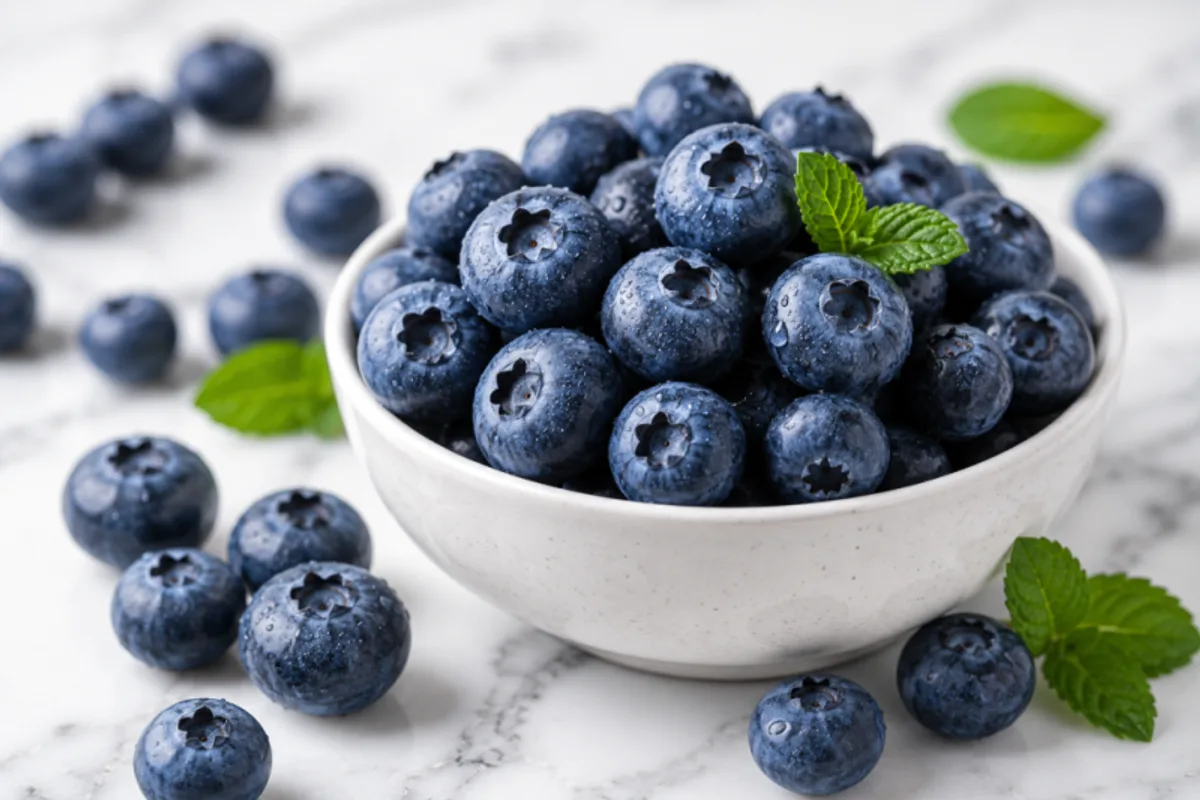
When you eat blueberries, your body digests natural sugars within a fiber-rich berry matrix while absorbing vitamin C, manganese, and anthocyanin pigments. Gut microbes interact with berry polyphenols during digestion. Research on berries and cardiometabolic health is promising but often observational—benefits come from regular produce patterns, not supplement-level doses from a handful alone.
Key takeaways
The essentials in plain language—useful before the deep dive.
✓
Blueberries deliver anthocyanins, vitamin C, and fiber in a low-calorie whole-food package.
✓
Polyphenols interact with digestion and gut microbes; whole berries differ from isolated extracts.
✓
Berry-rich dietary patterns associate with favorable cardiometabolic markers in population research.
✓
Frozen blueberries retain most nutrients and are a practical year-round option.
Quick answers
Short answers to common questions—details follow below.
Are frozen blueberries as nutritious as fresh?
Generally yes for most vitamins and anthocyanins. Frozen berries are picked at peak ripeness and are a practical year-round choice.
Do blueberries improve memory?
Some small trials show signals, but evidence is not strong enough to treat blueberries as a memory treatment. They fit well in overall brain-healthy dietary patterns.
How many blueberries should you eat per day?
There is no magic number. A half-cup to one cup as part of varied produce is a reasonable everyday range for most healthy adults.
Are blueberries high in sugar?
They contain natural fruit sugars with meaningful fiber. Whole berries typically have a more moderate glycemic impact than sugary drinks.
What happens if you eat blueberries every day?
You mainly get fiber, vitamin C, and anthocyanin-rich fruit within a low-calorie produce pattern.
Are wild blueberries better?
Wild berries are often denser in anthocyanins per gram, but any blueberries you will eat consistently help.
What happens over time
A typical timeline after eating Blueberry—not a personal medical forecast. Individual responses vary.
●
0–15 minutes
Step 1 Evidence: Moderate
First bites
What happens: Skin rupture releases juice and anthocyanin pigments. Saliva and chewing begin carbohydrate breakdown while fiber structures the meal bolus.
Pattern certainty: typical
●
30 minutes–2 hours
Step 2 Evidence: Moderate
Digestion & absorption
What happens: Sugars absorb into the bloodstream; fiber slows gastric emptying modestly compared with juice. Many polyphenols are transformed by gut microbes rather than absorbed intact.
Pattern certainty: typical
●
Several hours
Step 3 Evidence: Emerging
Gut interaction
What happens: Berry fiber feeds fermentation; microbial metabolism of polyphenols may produce bioactive metabolites still under active research.
Pattern certainty: variable
●
24 hours–1 week
Step 4 Evidence: Moderate
Daily pattern
What happens: Regular berry servings add variety to fruit intake and micronutrient diversity across the week.
Pattern certainty: typical
●
Weeks to years
Step 5 Evidence: Moderate
Longer-term pattern
What happens: Higher berry and produce intake patterns associate with better diet quality and some favorable cardiometabolic markers—not proof that blueberries alone prevent disease.
Pattern certainty: typical
●
0–15 minutes
Evidence: Moderate
First bites
What: Skin rupture releases juice and anthocyanin pigments. Saliva and chewing begin carbohydrate breakdown while fiber structures the meal bolus.
●
30 minutes–2 hours
Evidence: Moderate
Digestion & absorption
What: Sugars absorb into the bloodstream; fiber slows gastric emptying modestly compared with juice. Many polyphenols are transformed by gut microbes rather than absorbed intact.
●
Several hours
Evidence: Emerging
Gut interaction
What: Berry fiber feeds fermentation; microbial metabolism of polyphenols may produce bioactive metabolites still under active research.
●
24 hours–1 week
Evidence: Moderate
Daily pattern
What: Regular berry servings add variety to fruit intake and micronutrient diversity across the week.
●
Weeks to years
Evidence: Moderate
Longer-term pattern
What: Higher berry and produce intake patterns associate with better diet quality and some favorable cardiometabolic markers—not proof that blueberries alone prevent disease.
Nutrient snapshot
Serving size: 1 cup fresh blueberries (~148 g)
At a glance
Calories
84 kcal
Protein
1.1 g
Fat
0.5 g
Carbs
21 g
Fiber
3.6 g
Sugar
15 g
Vitamin highlights
Vitamin C ~14 mg 16% DV
Vitamin K ~29 mcg 24% DV
Minerals
Manganese ~0.5 mg 22% DV
Potassium ~114 mg 2% DV
% Daily Value based on a general 2,000-calorie reference diet where shown. Values are approximate.
Source: USDA FoodData Central (approximate values for raw blueberries)
Benefits
Potential upsides when this food fits a balanced pattern—not guaranteed outcomes for every person.
Anthocyanin-rich whole food
Evidence: Moderate
Blueberries are among the most anthocyanin-dense common fruits, supporting colorful produce patterns studied for cardiovascular and cognitive health associations.
Berries can carry surface residues; wash fresh berries and follow local guidance on organic choices if that matters to you.
Sugar in large portions
A cup is reasonable; multiple cups daily still add sugars and calories that count toward totals.
Who should limit this food
Educational context only—not a diagnosis tool. When in doubt, ask a qualified clinician.
!
Salicylate sensitivity
Rare individuals report sensitivity to compounds in berries; avoid if you have confirmed reactions.
!
Diabetes management
Whole berries often fit well, but portions and pairing matter—use personal glucose data and clinician advice.
!
Warfarin therapy
Vitamin K content is modest per cup but consistency matters on anticoagulant plans—coordinate with your clinician.
!
Young children
Whole berries can be a choking hazard for toddlers—crush or slice age-appropriately.
How much & how often
A typical serving is ½–1 cup fresh or frozen blueberries. Many dietary patterns encourage varied fruit daily; berries are one high-quality option among many—not a required daily quota.
Human evidence for blueberries mixes small clinical trials (often concentrated extracts or powders) with larger observational studies on berry-rich diets. Whole-food effects at realistic doses are plausible but less dramatic than headlines suggest. Fiber and produce-pattern benefits are the strongest, most actionable story.
Evidence in this article
Randomized trials (often extracts)
Short-term studies on blood pressure, insulin, or cognition using blueberry powders or juices.
Observational cohorts
Berry intake associated with diet quality and health markers over years.
Mechanistic research
Gut microbial metabolism of anthocyanins and in vitro antioxidant assays.
Hierarchy of evidence
1
Systematic reviews & guidelines
Highest synthesis
2
Randomized trials
Strong causal designs
3
Observational studies
Association signals
4
Mechanistic / lab
Hypothesis-generating
Higher on this list generally means stronger confidence for public guidance—but every design has limits.
Research limitations
Many trials use extracts, not whole berries at kitchen doses.
Cognitive and cardiometabolic headlines often overread short trials.
Wild vs cultivated varieties differ in polyphenol density.
In depth
The short story
Blueberries are small, water-rich fruits packed with anthocyanins—the pigments that stain your fingers purple. Your body digests their sugars and fiber like other berries while gut microbes process many polyphenols along the way.
Polyphenols vs whole food
Anthocyanin research is active and often exciting, but whole blueberries are not blueberry extract capsules. Kitchen portions support produce-rich patterns; they do not automatically deliver clinical-trial doses used in some studies.
Brain and heart context
Berry-rich diets show up in observational research linked with favorable cardiovascular and cognitive health markers. That is association within broader lifestyles—not proof that a daily handful reverses disease.
Practical tips
Use frozen berries freely in yogurt, oatmeal, and smoothies.
Wash fresh berries gently under cool running water.
Pair with protein or fat for a more satisfying snack.
Treat “superberry” marketing with healthy skepticism.
Bottom line
Blueberries are a nutrient-dense, low-calorie fruit worth eating regularly as part of varied produce. Your body handles them like other berries—digest, absorb, ferment fiber—and long-term value tracks with overall diet quality.
Frequently asked questions
Are frozen blueberries as nutritious as fresh?
+
Generally yes for most vitamins and anthocyanins. Frozen berries are picked at peak ripeness and are a practical year-round choice.
Do blueberries improve memory?
+
Some small trials show signals, but evidence is not strong enough to treat blueberries as a memory treatment. They fit well in overall brain-healthy dietary patterns.

 Evidence: Strong
 Evidence: Strong
 Evidence: Moderate
 Evidence: Moderate
 Evidence: Strong
 Evidence: Strong